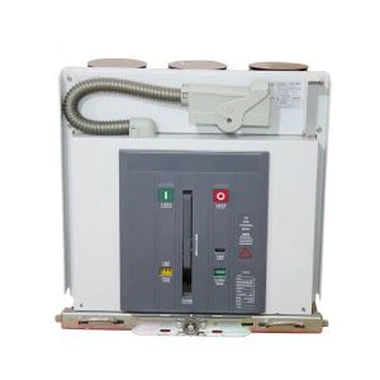
Why is the vacuum circuit breaker vacuum?
Oct 20, 2021
These are named after the arc extinguishing medium, and the nature of the arc extinguishing medium determines the strength of the arc extinguishing ability. The vacuum circuit breaker has a strong arc extinguishing ability and can quickly extinguish the arc. But in fact, there is no vacuum inside. Some air will be added deliberately for safety. The contacts of ordinary circuit breakers are in an atmospheric environment. When the contact is closed or disconnected in a circuit with a higher voltage and a higher current, the air between the contacts will be ionized, causing an arc to cause the switch to work abnormally. The contacts of the vacuum circuit breaker work in a vacuum environment, and the vacuum state remains between the contacts after the contacts are disconnected, which eliminates the possibility of air being ionized. Therefore, this type of circuit breaker is called a vacuum circuit breaker. The vacuum in it means that the environment where the contacts of the circuit breaker are located is free of air.
The main body of the circuit breaker can be divided into two parts, the operating mechanism and the arc extinguishing device. The vacuum circuit breaker will have a vacuum interrupter in which there is a vacuum. When the contacts are separated, the arc can be effectively extinguished, so it is called a vacuum circuit breaker.
In the process of switching on and off the load current or fault current of the vacuum circuit breaker, the contacts continue to wear, so that the over-travel is continuously reduced. Therefore, the overtravel of the circuit breaker must be measured regularly. For those that do not meet the requirements, adjust in time to ensure that there is enough second pressure between the contacts to ensure good contact. Generally, an over-travel measurement should be performed every time a vacuum circuit breaker breaks 2000 times, or breaks short-circuit current twice, and is newly put into operation for 3 months.