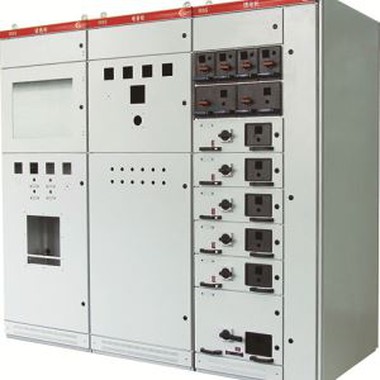
What is switchgear and its types?
Aug 20, 2020
The switchgear consists of one or more low-voltage switchgear and related control, measurement, signal, protection, adjustment and other equipment. The manufacturer is responsible for completing all internal and mechanical connections, and is a complete assembly of structural components. Kind of combination.
The main function of the switchgear is to open and close, control and protect electrical equipment during the process of power generation, transmission, distribution and power conversion of the system.
The structure of the switchgear is roughly similar, which is mainly divided into busbar room, room, secondary control room (instrument room), and feeder room. Generally, there is steel plate isolation between each room.
The interior includes: bus (busbar), circuit breaker, conventional and integrated relay protection device, measuring instrument, isolating knife, indicator light, grounding knife, etc.
What are the classifications of switch cabinets?
From the application point of view, the switchgear can be divided as follows:
(1) Incoming line cabinet: also called power receiving cabinet, it is the equipment used to receive electric energy from the power grid (from incoming line to busbar). Generally, it is equipped with circuit breakers, ct, pt, isolating knife and other components.
(2) Outgoing cabinet: also called feeder cabinet or, it is the equipment used to distribute electric energy (from the bus to each outlet), generally also installed with circuit breakers, ct, pt, isolating knife and other components.
(3) Busbar connection cabinet: also called busbar breaker cabinet, which is used to connect two sections of busbars (from busbar to busbar). Busbar connection is often used in single busbar segmentation and double busbar systems to meet user selection The requirements of different operation modes or the guarantee of selective load removal in case of failure.
(4) Pt cabinet: voltage cabinet, usually installed directly on the bus bar to detect the bus bar voltage and realize the protection function. Mainly install pt, isolating knife, fuse and arrester inside.
(5) Isolation cabinet: It is used to isolate the busbars at both ends or to isolate the power receiving equipment from the power supply equipment. It can provide a visible end point for the operator to facilitate maintenance and repair operations. Since the isolation cabinet does not have the ability to break and switch on the load current, the handcart of the isolation cabinet cannot be pushed or pulled when the circuit breaker matched with it is closed. In general applications, it is necessary to set the interlock between the auxiliary contact of the circuit breaker and the isolated handcart to prevent misoperation by the operator.
(6) Device cabinet: also called compensation cabinet, which is used to improve the power factor of the power grid, or for reactive power compensation. The main components are groups of groups connected in parallel, switching control circuits and fuses. And other protection appliances. Generally, it is installed in parallel with the incoming cabinet, and one or more capacitor cabinets can be operated in parallel.
After the capacitor cabinet is disconnected from the power grid, because the capacitor bank takes a while to complete the discharge process, it is not possible to directly touch the components in the cabinet, especially the capacitor bank; within a certain period of time after the power failure (according to the capacitor bank The capacity depends on the size, such as: 1 minute), re-closing is not allowed to avoid over-voltage damage to the capacitor. When performing automatic control functions, pay attention to the reasonable allocation of the switching times of each group of capacitor banks, so as to avoid one group of capacitors from being damaged, but other groups are rarely switched on.
(7) Metering cabinet: It is mainly used for measuring electric energy (kWh), and it is divided into high voltage and low voltage. Generally, it is installed with isolation switch, fuse, ct, pt, active watt-hour meter (traditional meter or digital meter ), reactive power meters, relays, and some other auxiliary secondary equipment (such as load monitors, etc.).
(8) Gis cabinet: also called closed combined electrical cabinet, it is a closed combination of circuit breakers, disconnectors, grounding switches, ct, pt, arresters, busbars, etc. in a metal shell, and then has good insulation performance and arc extinguishing performance The gas (usually sulfur hexafluoride sf6) is used as an insulation measure between phases and the ground, which is suitable for high-voltage and high-capacity power grids for distribution and control.